1839 KEY YEAR IN THE DEVELOPMENT OF PHOTOGRAPHY IN ENGLAND
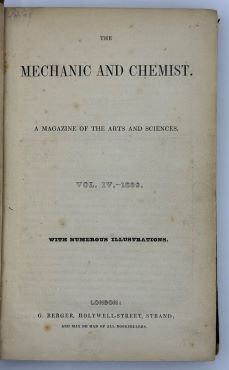
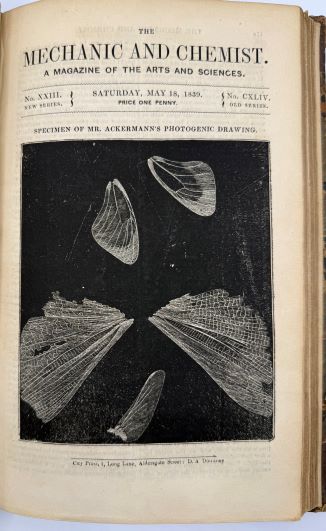
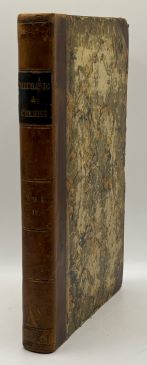
BERGER, G [PUBLISHER].: The Mechanic and Chemist. A Magazine of Arts and Sciences. Vol IV. -1839. With numerous illustrations.
London, G Berger, [1839].
Volume 4 only, comprising issues New Series I -XLIX, Jan -Sept 1839]], 8vo, pp iv, 392, [6, index], wood-engravings in text, bound in contemporary half calf, spine gilt ruled with black label, binding rubbed but sound, occasional spotting or soiling internally but quite sound and tight, a good copy,FIRST EDITION. With volume four of this periodical a new series was commenced of 'The Penny Mechanic and Chemist' with the word 'Penny' dropped for the name. It remained, however, a notable penny weekly for the artisan with scientific interests such as were being cultivated widely in Mechanic Institutions throughout the country. In one respect at least, the year of this volume, 1839, was notable in the scientific community: the possibilities of photography through various chemical processes developed by Daguerre and Fox Talbot were being widely discussed, with much attention given in the 48 weekly issues of 'The Mechanic and Chemist.' In the January 19th issue appears the headline ' 'Extraordinary Chemical and Optical Discovery'...M Daguerre has succeeded in fixing upon paper...the rays that are directed on the table of the camera obscura...an exact representation , in light and shade, of whatever object may be wished to be viewed...' and on February 9th a further article expands on the first '...In these pictures may be perceived even the time of day...' An account of Fox Talbot's memoir to the Royal Society appeared later that month, while Talbot's claim of priority is discussed in an article of March 3rd. Daguerre's actual chemical process is laid on on March 9th, whilst issues of priority continued to rage both sides of the English Channel. The most considerable article, entitled 'Photogeny. Discovery of MM Niepce and Daguerre' spanning over 6 columns, appeared on August 31st, whilst wood-engraved illustrations of 'Photogenic Printing' and 'Pictures formed by the Action of Light' had appeared in previous months. Together these, as well some other articles, suggest the excitement generated in 1839 by the prospect of permanent photographs. Gernsheim, in his ‘Incunabula of British Photographic Literature' includes other periodical of that year, but not this one which has beendismissed all too readily by later scholars as a cheap penny periodical for the masses. In reality, its articles are both series and detailed, suggesting a very cultivated, if likely not rich, audience. SOLD
HERALDIC BLAZON BY A TRAVELLER TO AMERICA 1682
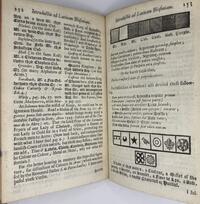
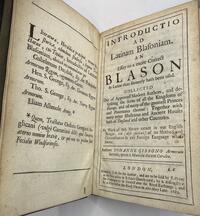
Authore Johanne Gibbono armorum servulo, quem a` Mantelio dicunt Cæruleo.
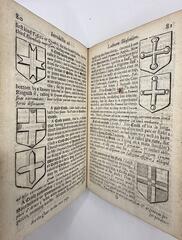
London : printed by J. M[acock]. for the author, and are to be sold by J. Crump...by B. Billingsley ... and by A. Churchill, 1682. Small 8vo, pp [16], 165, [3], wood-engravings of heraldic shields throughout text which is mainly English with some Latin, some phrases highlighted in black-letter, with an imprimatur leaf before the title, bound in early 19th Century straight-grained roan morocco, spine gilt, minor wormhole to spine at head, one or two rust-spots but a very good clean crisp copy internally.FIRST EDITION, indeed the sole edition of this unusual heraldic treatise by John Gibbon who left England for Virginia in 1659, returning three years later; as a plantation manager he came into close contact with native Indians and their customs, seeing a relationship between their body paint and European heraldry. This perception he embodies in this work; after citing a number of authorise on American practices he goes on 'A great part of Anno 1659... I lived in Virginia, being most hospitably entertained by...Rich Lee....I saw a war-dance acted by the Natives. The Dancers were painted...' He goes on to describe the colours and painting in heraldic terms, clearly suggesting the relationship. As a whole Gibbon's books, though highly informative, is written in a charmingly discursive, at times informal, style, far more interesting than its somewhat formidable Latin title would suggest. £285.00 [ref 0884]
UNRECORDED COLOURED COPY OF RAYNER’S HADDON HALL
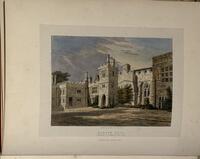
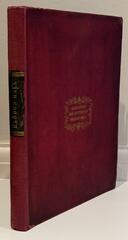
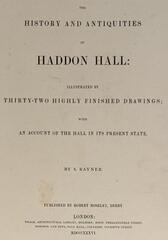
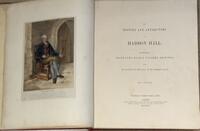
HADDON HALL. RAYNER, SAMUEL. [1806-1879].: The History and Antiquities of Haddon Hall : illustrated by thirty-two highly finished drawings ; with an account of the hall in its present state by S. Rayner.. bound with: Supplementary Number to Rayner's Haddon Hall.
Derby & London, R. Moseley, Weale 1836-37
2 parts in 1 volume, folio, [or vary large 4to], pp [4], [4], 53, [1, list of plates, [2, subscribers]; [4], with frontispiece portrait of William Hage, 34 lithographed plates of interior and exterior view of the hall ALL HAND-COLOURED PROOFS ON INDIA PAPER, with a further 8 tinted lithograph plates in the supplement [including one plan and 7 plates of architectural details], bound in original textured red cloth, titled in gilt to upper board, sometime neatly rebacked in red cloth preserving original cream endpapers and original black leather label, all edges gilt, a little rubbed and bumped at edges of binding, Internal with edge foxing to supplementary plates at the end, else clean and bright throughout,
FIRST EDITION, LARGE PAPER COPY, WITH THE SUPPLEMENT, a possibly unique copy with the plates in unrecorded hand-coloured state. In August 2025 Haddon Hall hosted an exhibition of the lithographic views contained in this work put along side the same views in contemporary photography, thus demonstrating the accuracy of the originals and the extent of the post 1920 restorations to the building both inside and out. ' To quote 'Derbyshire Life' ' ‘Samuel Rayner’s [sic] Haddon Hall – Revisited’ presents the work of Samuel Rayner, artist and author, who in the early part of the 19th century studied intricately the architectural details of Haddon Hall, near Bakewell, creating over thirty sketches of the property in its ‘then’ state.' Rayner's work dated from the last year of William IV's life in 1836 and his patron's were both The Duke of Rutland and the Queen. Rayner included in his published work a fairly brief text of 58 pages which included much anecdotal material supplied by the hall's then keeper and guide William Hage, depicted in the frontispiece to the volume in his Hall setting. The resulting book would become a masterpiece of mediaeval English architectural delineation, its accuracy demonstrated by the exhibition's contemporary photographic studies meticulously prepared by a group of professionals. The present large paper copy, which unfortunately bears no marks of provenance, would appear to be the only one known with the plates finely hand-coloured, including the frontispiece, each a proof impression on India paper mounted on think card paper. The plates number 35 in total, plus 8 in the supplement. £850.00 [ref 1416]
EARLY SILVERSMITH’S HANDBOOK OF COATS OF ARMS.CIRCA 1745
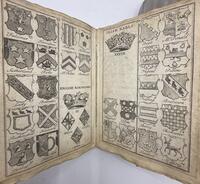
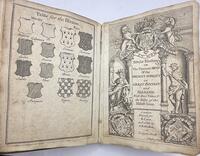
HERALDRY. CAVE, EDWARD [PUBLISHER].: Tabulæ Illustres or the Paternal Arms of the Present Nobility of Great Britain and Ireland, with their titles & the stile of the eldest sons.
London : printed for E. Cave, and sold by J. Robinson, in Ludgate Street, [1745?]
12mo, comprising elaborate pictorial title page, frontispiece 'table of blazons', 27 plates multiple family crests, engraved throughout plus 7 typeset pages of index at the end, all plates neatly cut down at margins and laid down on paper, 36 leaves in all, as required, bound in contemporary hard vellum, titled in manuscript to spine, evenly discoloured, minor soiling, a sound copy throughout.
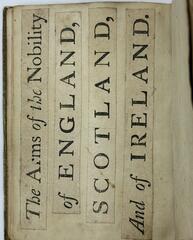
FIRST EDITION, with updates to 1744; a later edition updates to 1748. This little pocket compilation by Edward Cave was prepared for use by silver- and goldsmiths and other craftsmen needing handy reference for arms of the nobility, usually for engraving purposes. This copy was made more durable at the time by mounting all the leaves on paper and binding in strong vellum, which has certainly done its job here. A curious feature - perhaps a binder's whim - is a vertical typographic pre or half title made up of words cut out, presumably from the original wrapper. The book has a certain practical charm. £125.00 [ref 0885]
HODDESDON’S LIFE OF MORE, ANNOTATED & WITH PORTRAITS 1652
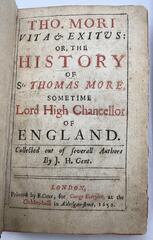
HODDESDON, JOHN [active 1650].: Tho. Mori Vita & Exitus: or, The history of Sr. Thomas More, sometime Lord High Chancellor of England. Collected out of severall authors by J.H. Gent.
London, printed by E. Cotes, for George Eversden, 1652.
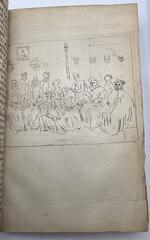
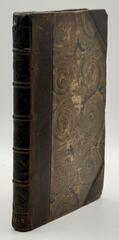
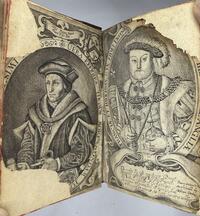
Small 8vo, pp [16], 150, lacking the final blank, title page in red and black, with double portrait frontispiece of Thomas More and Henry VIII [both with corner damage and loss to engraved area, both laid down], 2 18th century portraits inserted, bound in early 19th Century half calf, rubbed and a bit worn, one page with repaired tear touching text but without loss, else internally sound.
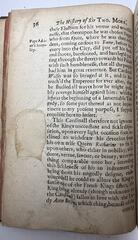
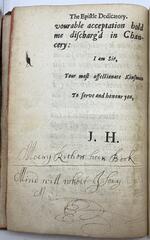
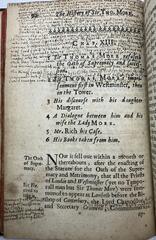
FIRST EDITION; this, The Fox Pointe copy, has two distinct points of interest; firstly, despite the loss to corners of images’ frames, the presence of the plate of Henry VIII in addition to Thomas More is unusual if not distinctly rare. In both case the actual head image is unaffected. Secondly, chapter 13 of Hoddesdon's biography deals with the critical issue of More's refusal to sign the Oath of Supremacy and consequent arrest and imprisonment the Tower. This most vital part of More's life has been annotated within the blank spaces of several leaves in a fine early hand. The several passages commence 'Cranmer and others administd the oath of succession to ye clergy... The ArchBp was one employed abt the Act of Succession, it was made the last sessions of Parlt wch was to invest the succession to the Crown upon the heirs of Q Anne...' These annotations taken together constitute a substantial and interesting 17th Century addition our copy. Although it bears only two ownership signatures within the prelims - viz John Bridges and Mary Rithor, neither show the kind of educated hand of the annotator. £550.00 [ref 0892]
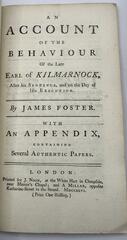
JACOBITE UPRISING. FOSTER, JAMES. [1697-1753].: An Account of the Behaviour of the late Earl of Kilmarnock, after his sentence, and on the day of his execution. By James Foster. With an appendix, containing several authentic papers.
8vo, pp [2], 51, [3, adverts], with half title, later neat patterned wrappers, a fine clean copy.
FIRST EDITION, issue with the "L" of "Late" in title capitalised. The Earl of Kilmarnock was one of the leaders of the Jacobite rebellion captured after Culloden, his eventual execution a foregone conclusion. James Foster, a Baptist Minister and preacher at Pinner's Hall, accepted to deliver the sacrament to Kilmarnock in prison before he was delivered to the scaffold on Tower Hill; Foster subsequently published this account of Kilmarnock's words and behaviour before sentence was carried out on the 18th August 1746, and his apparently sympathetic approach sparked immediate controversy amongst the clergy, especially in the Church of England. Foster was accused of cultivating Jacobite sympathy within the dissenting community, and the approbation that followed is said to have led to Foster's decline and eventual death. £95.00 [ref 1435]
KENNETT’S DAILY DIARY OF EVENTS FROM 1660 TO 1662 LARGE FOLIO
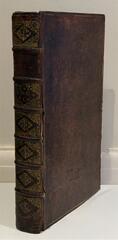
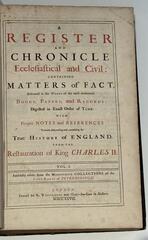
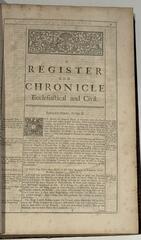
KENNETT, WHITE. [1660-1728].: A Register and Chronicle Ecclesiastical and Civil: containing matters of fact, Delivered in the Words of the most Authentick Books, Papers, and Records; digested in exact order of time. With proper notes and references towards discovering and connecting the true history of England from the Restauration of King Charles II. Vol.1. Faithfully taken from the manuscript collections of the Lord Bishop of Peterborough.
London, printed for R. Williamson, 1728.
Volume One only [all published], tall folio, [height 40cm] pp [12],938,[22], title page in red and black, main text within double columned borders with copious side-notes, bound in contemporary calf, sides with double gilt fillet borders, spine gilt with raised bands, lacking label, rubbed and cracked at joints, but still sound and solid, with light foxing to last leaf, a couple of blank margins cut away [presumably for use elsewhere - paper repairs?], else clean and tight throughout, a good copy.
FIRST EDITION; Death would prevent the renowned historian and Bishop of Peterborough from issuing further volumes of this monumental work, though much more had been readied in preparation; all his original manuscript material survives in the British Library. Commencing on January 1st 1660 and concluding December 31st 1662, Kennett details the daily course of events in the Country in fields of politics and national interest, centred, of course, around the restoration of the monarchy and resulting change within parliamentary democracy, ruling elites and political establishments. As a record of a short window in time of national importance it is perhaps unparalleled, a massive and weighty document of imposing proportions [60 copies of a large paper edition were also printed off by Bowyer in addition to the 620 ordinary ones such as this - though the size of this example seems quite sufficient]. The work itself is said to identify the authorship of many anonymously published works of the period [DNB]. £250.00 [ref 1423]
PRIVATELY PRINTIED HISTORY OF EARLY CAMBRIDGE BUILDING
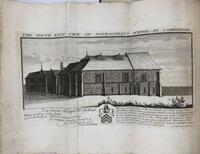
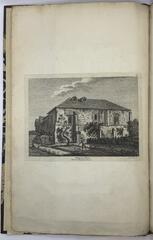
KILNER, REV JOSEPH.: The Account of Pythagoras's School in Cambridge; as in Mr. Grose's Antiquities of England and Wales, and other notices.
[?Cirencester, for the author, 1792]
Small folio, pp v,[1],5-56,[4],59-158, 9 engraved plates, 2 folding, including a view of the school by S. and N. Buck, uncut in neat modern half calf, spine gilt with raised bands, red label, marbled sides, laid paper endpapers, short repaired tear to one plate, light edge foxing and offsetting to plates, but a very good attractive copy.
FIRST EDITION; the so called 'Pythagorus's School, part of Cambridge University, is famous still as the City's oldest surviving secular building. Grose had provided a succinct description of the building in his 'Antiquities' of 1782, and based upon this Joseph Kilner of Cirencester, formerly of Merton College, Oxford who actually owned Pythagorus's School, prepared this fuller illustrated treatment of the subject, thought to have been printed in Cirencester itself. A pleasing copy. £250.00 [ref 1419]
THORESBY’S LEED’S MUSEUM OF ANTIQUITIES FIRST EDITION 1715
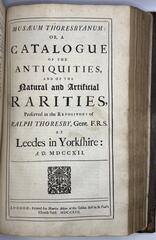
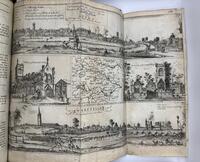
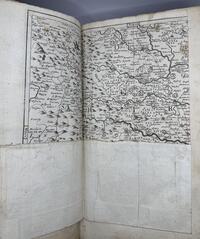
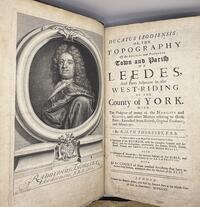
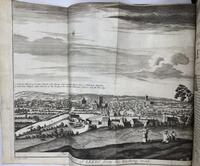
THORESBY, RALPH. [1658-1725].: Ducatus Leodiensis: or, The Topography of the Ancient and Populous Town and parish of Leedes, and parts adjacent in the West-Riding of the county of York. With the pedigrees of many of the nobility and gentry, and other matters relating to those parts extracted from records, original evidences, and manuscripts. By Ralph Thoresby, F. R. S. To which is added, at the request of several learned persons, a catalogue of his musaeum, with the curiosities natural and artificial, and the antiquities; particularly the Roman, British, Saxon, Danish, Norman, and Scotch coins, with modern medals. Also a catalogue of manuscripts; the various editions of the Bible, and of books published in the infancy of the art of printing. With an account of some unusual accidents that have attended some persons, attempted after the method of Dr. Plot.
London, printed for Maurice Atkins, and sold by Edward Nutt, 1715.
2 parts in one volume, folio, pp iv, [2], v-xxii, 4, 5-6, 5-108, 109-114, 109-268, [3], 276-628, [12], separate title page to the second part, with 13 plates including frontispiece portrait of Thoresby and folding map, 5 of the plates being folding, plus many smaller engraved heraldic and other plates in the text, bound in contemporary panelled calf, worn and restored to corners and edges, joints cracked but holding securely, spine ends worn , plates with a few repaired tears but no loss, a sound tight working copy of this substantial work.
FIRST EDITION; this the first history of Leeds was issued by subscription, a prospectus issued the previous year. Thoresby went much further in his work than the usual local historian or even parochial antiquarian, expanding the area of interest to including parts of the rest of the county, and including as part two, a separate work detailing the contents of his private museum, in his lifetime 'widely regarded as the finest of his day', though Gough would write of him that 'credulity and want of judgement in collecting his curiosities must be charged on the infancy of those pursuits in the age he lived in.' [Rosemary Sweet 'Antiquaries.']. £375.00 [ref 1425]