
1839 KEY YEAR IN THE DEVELOPMENT OF PHOTOGRAPHY IN ENGLAND
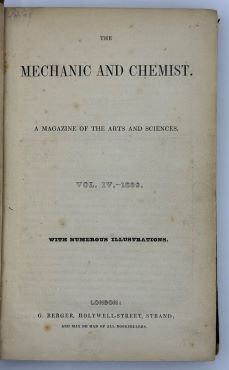
BERGER, G [PUBLISHER].: The Mechanic and Chemist. A Magazine of Arts and Sciences. Vol IV. -1839. With numerous illustrations.
London, G Berger, [1839].
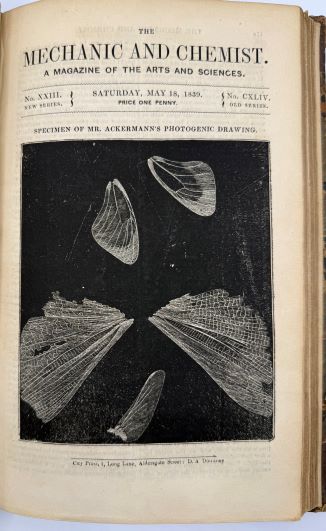
Volume 4 only, comprising issues New Series I -XLIX, Jan -Sept 1839]], 8vo, pp iv, 392, [6, index], wood-engravings in text, bound in contemporary half calf, spine gilt ruled with black label, binding rubbed but sound, occasional spotting or soiling internally but quite sound and tight, a good copy,FIRST EDITION. With volume four of this periodical a new series was commenced of 'The Penny Mechanic and Chemist' with the word 'Penny' dropped for the name. It remained, however, a notable penny weekly for the artisan with scientific interests such as were being cultivated widely in Mechanic Institutions throughout the country. In one respect at least, the year of this volume, 1839, was notable in the scientific community: the possibilities of photography through various chemical processes developed by Daguerre and Fox Talbot were being widely discussed, with much attention given in the 48 weekly issues of 'The Mechanic and Chemist.' In the January 19th issue appears the headline ' 'Extraordinary Chemical and Optical Discovery'...M Daguerre has succeeded in fixing upon paper...the rays that are directed on the table of the camera obscura...an exact representation , in light and shade, of whatever object may be wished to be viewed...' and on February 9th a further article expands on the first '...In these pictures may be perceived even the time of day...' An account of Fox Talbot's memoir to the Royal Society appeared later that month, while Talbot's claim of priority is discussed in an article of March 3rd. Daguerre's actual chemical process is laid on on March 9th, whilst issues of priority continued to rage both sides of the English Channel. The most considerable article, entitled 'Photogeny. Discovery of MM Niepce and Daguerre' spanning over 6 columns, appeared on August 31st, whilst wood-engraved illustrations of 'Photogenic Printing' and 'Pictures formed by the Action of Light' had appeared in previous months. Together these, as well some other articles, suggest the excitement generated in 1839 by the prospect of permanent photographs. Gernsheim, in his ‘Incunabula of British Photographic Literature' includes other periodical of that year, but not this one which has beendismissed all too readily by later scholars as a cheap penny periodical for the masses. In reality, its articles are both series and detailed, suggesting a very cultivated, if likely not rich, audience. £150.00